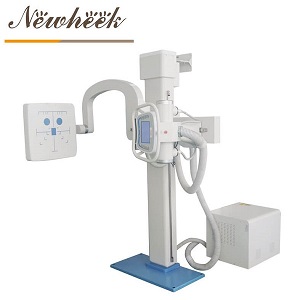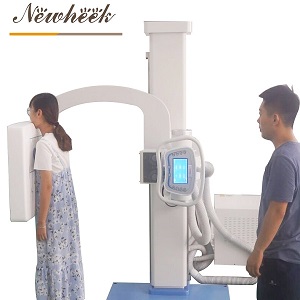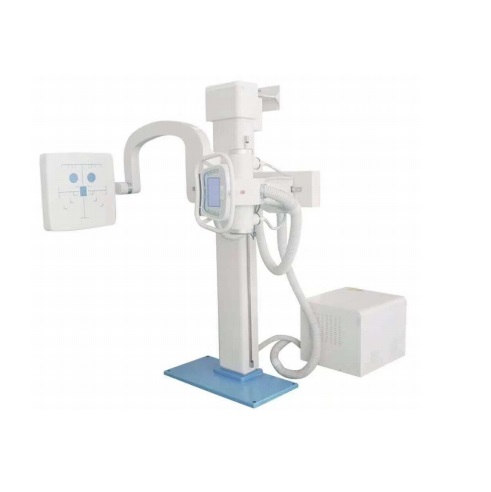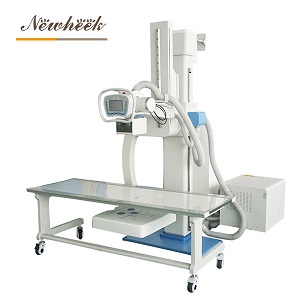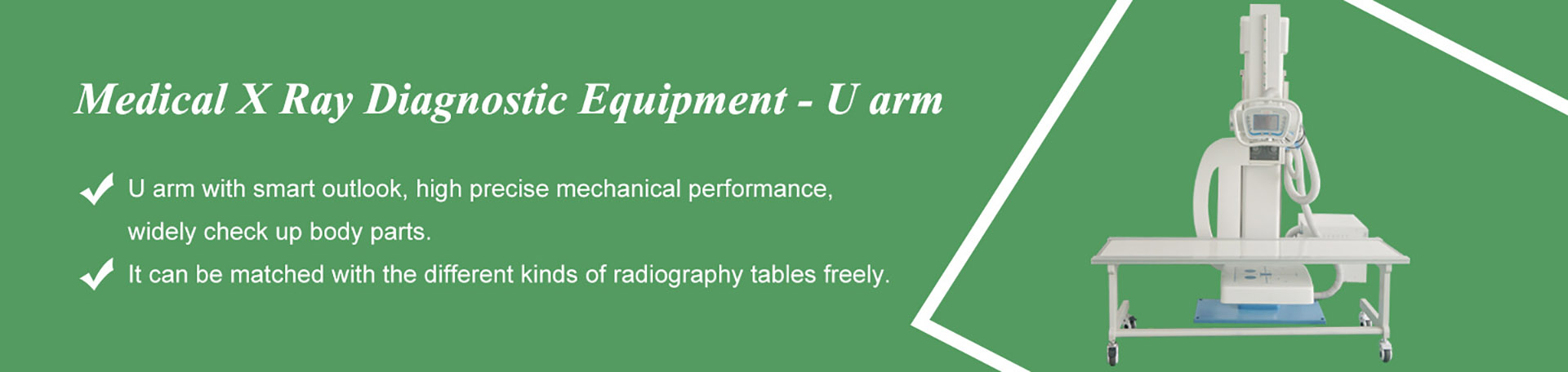

A U-arm and a C-arm are two different classes of X-ray equipment that share a letter-shaped frame name. A U-arm is a stationary digital radiography (DR) system: the X-ray tube and a flat panel detector sit at the two ends of a U-shaped arm carried on a floor column, and the arm moves around a patient who stays in one position to produce static projection images. A C-arm is a fluoroscopy system used during surgical and interventional work, producing continuous or pulsed live images. The name on an inquiry is not a reliable specification for either one. What determines whether a quotation matches the requirement is six written lines in the request for quotation: imaging mode, clinical setting, receptor type, patient positioning, room and services, and documentation. This article addresses that specification gap. U-arm DR systems are the product line covered on this site; the C-arm is described here as a purchasing distinction and is not offered as a product line.

The confusion has a structural cause rather than an individual one. Both machines are named after the shape of a rigid arm that holds an X-ray source and a receptor at opposite ends. Both are commonly shortened to “arm machine” in loose translation. Suppliers and resellers do not apply the labels consistently, and a third label, UC arm, is also in circulation; the naming is covered separately in the UC arm naming article and is not repeated here. The concern in this article is what happens after a name is written into a purchasing document.
In practice, an inquiry that says “C-arm” can be sent to a supplier of stationary DR systems, and a requirement for routine chest and spine radiography can be quoted as a fluoroscopy unit. Neither party has made a technical error at that point; both have simply treated a shape name as though it were a specification. The correction is not a terminology lesson, it is a written configuration sheet.
Machine-translated keyword lists compress the three labels into one entry. Second-hand equipment listings often carry only the frame name in the title. A reseller paraphrasing a hospital’s requirement may drop the words that identify the imaging mode. In each case, the information that distinguishes the two machines is the information that was removed during rewriting.
The comparison below is written as a purchasing checklist, not as a technical rating. It is deliberately qualitative: numerical performance, structural load figures and dose values belong in the manufacturer’s specification sheet and in the documents applicable to the destination market, not in a general article.
| Dimension | U-arm DR system | C-arm fluoroscopy unit |
|---|---|---|
| Imaging mode | Static projection radiography, one exposure per image | Continuous or pulsed live fluoroscopy, with image sequences during a procedure |
| Receptor | Static flat panel detector held in a bucky tray or detector holder | Image intensifier or dynamic flat panel detector, commonly described in general purchasing terms |
| Typical examination | Chest, spine, abdomen and extremity radiography across standing, seated and supine positions | Intraoperative localisation, orthopaedic reduction and interventional guidance |
| Where the equipment sits | Fixed radiography room; floor column paired with a radiographic table and an upright detector stand | Operating theatre or interventional suite; typically a mobile cart or a fixed surgical mount |
| What moves | The arm travels and rotates around a patient who stays in position | The unit is positioned around the surgical field and the table |
| Configuration lines in a purchase order | Generator, tube, collimator, arm, detector, acquisition workstation, table and upright stand | Fluoroscopy imaging chain, C-arm cart, monitor trolley, dose management functions and procedure accessories |
| Documentation requested | System registration, instructions for use, DICOM conformance statement, installation and site survey records | Fluoroscopy-specific registration and radiation-safety documentation applicable to the destination market |
The right-hand column is a general purchasing description of a category that this site does not supply. It is included so that a configuration sheet can be checked for completeness, not as a product offering. Where a requirement belongs to that category, the appropriate course is to approach a supplier of that equipment with the same six lines described below.
One distinction deserves particular attention because it is frequently tested in inquiries. A U-arm system configured with a bucky tray, static flat panel detector and acquisition workstation is built for static radiography, not for live fluoroscopy. The question is answered directly in Can a U-Arm Be Used for Fluoroscopy?, which explains the receptor and imaging-chain reason. An RFQ that asks for live imaging on a static DR configuration is describing two different machines in one line.
A request for quotation does not need a long narrative. It needs six lines that remove the ambiguity a frame name leaves behind. Each line below states what belongs in the document and what is left to assumption when the line is absent.
| # | Line to write | What the line states | What is left to assumption when it is missing |
|---|---|---|---|
| 1 | Imaging mode | Static radiography, continuous fluoroscopy, or a stated requirement for both | A DR system is quoted for a live-imaging requirement, or the reverse |
| 2 | Clinical setting | General radiography room, operating theatre or interventional suite | Room layout, shielding assumptions and accessory scope are guessed |
| 3 | Receptor | Static flat panel detector, image intensifier or dynamic detector; size and mounting method | Detector and holder are mis-specified and the arm cannot be correctly matched |
| 4 | Patient positioning | Standing, seated, supine and wheelchair access; table and upright stand requirements | The supplied configuration omits the table or upright capability actually required |
| 5 | Room and services | Floor and ceiling conditions, power provision and shielding, to be confirmed by site survey against the manufacturer’s specification | Installation is planned against assumed conditions rather than measured ones |
| 6 | Documentation and service | Registration, instructions for use, DICOM conformance, warranty scope, spare parts and response terms | Quotations are compared on price alone and after-sales scope stays undefined |
Line 1 — imaging mode. This single line separates the two categories more reliably than any product name. Where the requirement is static projection imaging, the DR configuration is the relevant one. Where live imaging during a procedure is required, the specification belongs to a different equipment class. Writing “both” without separating the two requirements produces a quotation that is difficult to compare, because the two functions sit on different imaging chains.
Line 3 — receptor. The receptor type and its mounting determine how the arm, the detector holder and the acquisition workstation are configured. A size or mounting method left blank is usually filled with a default, and the default may not match the examination list. The line should state the receptor type, the size and whether it is installed in a bucky tray or a dedicated holder. Detector technology itself is a separate subject; this line is about what goes into the purchase order, not how a detector is constructed.
Line 4 — patient positioning. A stationary U-arm system is normally specified together with a radiographic table and an upright detector stand, and the range of positions required should be written down. The comparison of U-arm, sickle arm and double-column layouts describes the layout choices, and the workflow notes on positioning patients with limited mobility show why wheelchair access and transfer-free positioning belong in the specification rather than in a later conversation. Where an upright stand is part of the requirement, the notes on tube-to-bucky alignment describe the coordination involved.
Line 5 — room and services. Floor and ceiling conditions, power provision and shielding are site-specific. A written RFQ records them as items to be confirmed by a site survey against the manufacturer’s specification. Measure Twice, Install Once: What to Check About the Room Before the U-Arm Ships sets out the survey items. Numerical load and clearance values are deliberately not listed here; they belong to the equipment specification and the survey record for the individual room.
Line 6 — documentation and service. A quotation is comparable only when the document set and the service scope are stated. What Compliance Files Should a U-Arm X-Ray System Come With lists the document categories commonly requested for the destination market. Warranty scope, spare part availability and response terms are separate lines in the same document. Cost discussions are more useful once these items are fixed; the overview of U-arm system cost explains why a price figure without a configuration sheet is not a comparable number.
Short inquiry emails. A request reduced to “please quote arm X-ray machine” carries no imaging mode and no clinical setting. The corrective action is to attach the six-line sheet to the first message, so that the first quotation is prepared against the same information as every later revision.
Reseller paraphrasing. When a requirement is retold through an agent or a trading company, descriptive qualifiers are often lost while the product-like label survives. Retaining the original requirement text as an attachment preserves the qualifiers that a paraphrase drops.
Second-hand and refurbished listings. A listing title frequently contains only the frame name. The receptor, the imaging mode and the installed accessories are the fields that identify what is actually being offered; those fields are the ones to request in writing before a listing is treated as comparable.
Machine-translated keyword lists. Translation tools tend to merge U arm, UC arm and C arm into a single term. A configuration sheet in plain technical language is more reliable than a keyword list for this category. The glossary-style explanation in Sickle Arm X-Ray Machine Explained may be used alongside the sheet, but the sheet is what a quotation is prepared from.
Where lines 1 to 4 resolve to static radiography in a general radiography room with a static flat panel detector, the requirement falls within the U-arm DR category covered on this site. The frame geometry, the motion range and the way the tube and detector remain aligned are described in the sickle arm explanation, and the difference between a U-arm layout and a double-column layout is set out in the U-arm versus double-column comparison. Routine upright and recumbent work is covered in the note on one-button upright and recumbent operation.
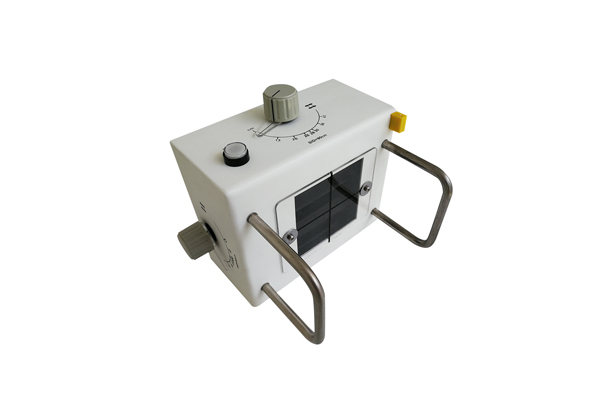
The system is normally quoted as a set of subsystems rather than as a single item. Product-level information is available on the U-arm digital X-ray machine page and the medical diagnostic U-arm page. Where a collimator is specified as a separate line item, the U-arm collimator page provides the component-level reference. Each of these pages corresponds to a line on the configuration sheet; none of them replaces the sheet itself.
Where a requirement resolves to live fluoroscopy in an operating theatre, it belongs to a different equipment category. This site does not supply that category, and no configuration or performance claim is made for it here. The same six-line sheet remains useful: it can be sent to an appropriate supplier so that the quotation is prepared against the same information.

No. One label describes a radiography platform and the other a fluoroscopy category; they are not interchangeable equipment classes. The naming and the motion-range explanation are covered in the UC arm naming article and are not repeated here. The shared letter is not an indication of shared scope.
A U-arm configured with a bucky tray, a static flat panel detector and an acquisition workstation is built for static radiography. Live fluoroscopy requires a different imaging chain. The reasoning is set out in Can a U-Arm Be Used for Fluoroscopy?. An RFQ that requires both functions should state them as separate requirements rather than as one machine.
Lines 1 and 3 are the ones to correct. Line 1 states static projection radiography, and line 3 states the static flat panel detector with its size and mounting. Reissuing the sheet with those two lines corrected is sufficient; the rest of the document can stay in place. Changing only the product name without correcting the imaging mode leaves the same ambiguity in the next quotation.
Shared scope should not be assumed. The two categories use different imaging chains and different accessories, so spare part lists and service terms are normally agreed separately for each system. The document categories that accompany a U-arm system are listed in the compliance files article, and the service scope belongs in line 6 of the same configuration sheet.
It includes what the configuration sheet lists. A table, an upright detector stand and their alignment with the arm are separate line items; a quotation prepared without those lines may cover the arm alone. The three-column layout comparison describes how the table and upright stand relate to the arm, and the six-line sheet is the place where their inclusion is recorded.
A frame name is a convenient label and an unreliable specification. The six lines described above take little space in a document and remove the ambiguity that produces incomparable quotations. Where the requirement resolves to a U-arm DR system, a written configuration sheet can be prepared against the examination list, the room survey and the document set applicable to the destination market.
Phone / WhatsApp: +86 19062611512 (WhatsApp) | Email: admin@newheek.cn | Contact us
Tel: +86 19062611512
Email : admin@newheek.cn
Company : Weifang Newheek Electronic Technology Co., Ltd.