
every radiographic room actually contains two motion systems — the tube carrier (on a U-arm, the arm itself) and the upright bucky stand. For most of the room’s workload they move independently. What separates the DR rooms being specified in 2026 is whether those two systems know where each other is: tube-to-bucky auto-tracking, auto-centering, stored presets and tilt compensation have moved from “ceiling-mounted luxury” language into mainstream floor-standing and U-arm room quotations. This article explains what those four capabilities actually do, how the market tiers them, when you genuinely do not need them, and the six questions to put to any vendor before you compare prices.
Scope note: this article describes industry-wide capability tiers based on publicly available 2026 equipment documentation. Whether a specific wall stand or U-arm configuration supports tracking or presets must be confirmed with the manufacturer in writing before purchase — see the RFQ questions in Section 6.

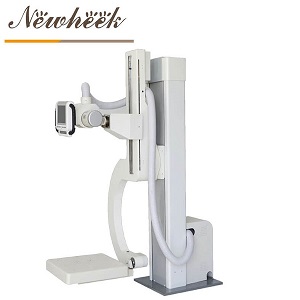
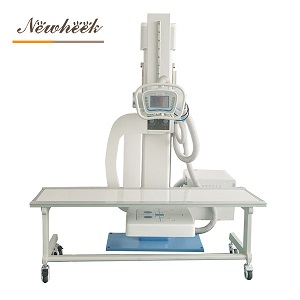
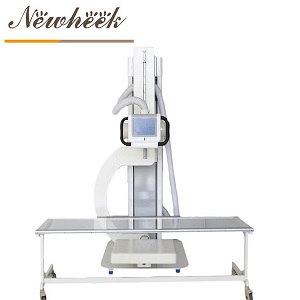
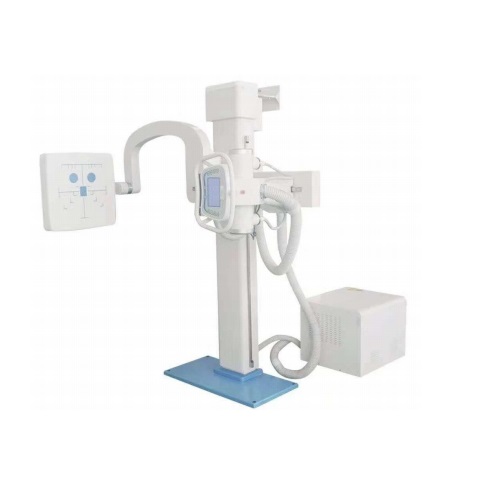
Walk into any U-arm room and you can physically point at both systems. The first is the arm: it carries the tube and the detector, rotates, tilts, and travels along a column. The second is the upright stand: a vertical bucky carrier that holds the grid and detector against the wall or on its own column, waiting for the patient to stand in front of it.
Most content about U-arm systems — including earlier articles on this site — is about the arm: its rotation range, its angulation, its table-and-wall-stand workflow. That emphasis is understandable; the arm is the moving spectacle. But chest radiography is among the highest-volume examinations in any general facility, and chest work happens at the upright half. The quiet question of 2026 is: when the work happens over there, at the wall stand, how well do the two halves cooperate?
On a fully manual room, the answer is: they don’t. The technologist moves the arm, then walks to the stand, then moves the stand, then returns to re-center the tube — aligning two separate devices by eye for every view. The arm and the stand are two strangers sharing a room.
Vendor brochures compress several distinct capabilities into the word “tracking.” When you compare rooms, it pays to know which of the four you are actually being offered:
A room can have any subset of these. “Motorized” and “linked” are not synonyms — which leads directly to the tier structure the market has settled into.
Based on publicly available specifications and brochures from international DR manufacturers in 2026 (specific models named in the reference notes for this article), radiographic rooms now cluster into three capability tiers:
| Tier | Tube half | Upright half | Who coordinates them? |
|---|---|---|---|
| Fully manual | Manual or spring-assisted movement | Manual height adjustment | The technologist, by eye, every time |
| Motorized but independent | Powered travel and angulation | Powered height (some with locking) | Still the technologist — two powered systems, no shared awareness |
| Linked / tracked | Powered, with encoder feedback | Powered, with encoder feedback | The system — tube follows bucky, presets recall both halves together |
One publicly listed specification from an international ceiling-mounted DR suite quotes upright auto-tracking accuracy in the region of ±2 mm; another manufacturer’s marketing emphasizes that SID and geometry are maintained even while the wall stand is tilting. These are vendor-published figures for their own suites — treat them as evidence of what the tier now means, not as a universal standard, and ask any vendor you evaluate to state their own number in writing.
The middle tier is the one buyers most often misunderstand. A room with a powered U-arm and a powered wall stand can still be motorized but independent: two systems that each move smoothly, coordinated by nothing but the technologist’s attention. Power removes physical strain (a subject covered in depth in our earlier article on motorized vs. manual stands); it does not by itself remove the alignment workload.
If linkage were only about convenience, it would be a hard sell. The clinical argument is narrower and stronger: the highest-risk moments in upright work are the transitions — from a tilted bucky position back to the standard standing chest, from one patient’s custom height to the next protocol’s default.
Two failure modes concentrate at those transitions:
That is why tilt compensation is the telling capability: if a room can tilt its wall bucky for kyphotic and seated patients (increasingly common, as covered in our article on upright imaging for patients who can’t stand), then every tilted view is also a geometry test. A system that re-aligns itself during the tilt removes that test from the technologist’s queue. A system that doesn’t hands the test back — and the technologist will pass it, most of the time, with their eyes. The question for a buyer is how much of the schedule they want spent passing it.
Honest purchasing advice has to run in both directions. A linked system commands a price premium, and there are rooms where that premium buys little:
None of this makes linkage a gimmick; it makes it volume-dependent. The busier the room and the more varied the upright workload — pediatrics, seated and wheelchair patients, tilted APs for kyphosis — the more of the day is spent in transitions, and the more a self-coordinating room repays its premium. Match the tier to the workload, not to the brochure.
Whichever tier you end up in, put these six questions to each vendor in writing, and compare the answers rather than the adjectives:
Ask the same six questions of every bidder, including for U-arm configurations. The answers will usually reorder the price list — and occasionally disqualify a quote — before any demonstration is scheduled.
No. An automated OTC refers to the ceiling-mounted tube suspension itself. Auto-tracking is a behavior — tube follows detector — that can be implemented on ceiling systems and, in various degrees, on floor-mounted and U-arm configurations. When comparing rooms, ask what the tracking behavior covers, not which component the marketing names.
Not meaningfully. Tracking requires the stand to report its position, which requires powered, encoded movement. A manual stand can sit in a room with a smart tube, but the tube has nothing to follow — the technologist remains the coordinator at the upright half.
Indirectly. Tracking does not change exposure factors, but by reducing positional misalignment it reduces one of the main causes of repeat exposures — and retakes are dose. Frame any dose discussion around repeat-rate reduction, and keep the facility’s overall practice aligned with ALARA principles and local radiation-safety regulations.
Start from the workload: views per day at the upright half, how often positions change (seated patients? tilted APs? pediatrics?), and staff count. High mix and high volume justify evaluating the linked tier; a narrow, low-volume workload can be well served by a motorized-independent room with good ergonomics. Either way, get the six questions of Section 6 answered in writing before comparing prices.
Planning a U-arm room and weighing the upright half’s options? Tell us your workload and room dimensions — we manufacture U-arm systems and a full range of side-mounted bucky stands and electric bucky stands, and we will answer the six questions above for our own equipment in writing. You can also reach us directly at admin@newheek.cn or +86 19062611512.
Tel: +86 19062611512
Email : admin@newheek.cn
Company : Weifang Newheek Electronic Technology Co., Ltd.