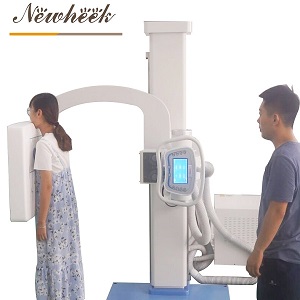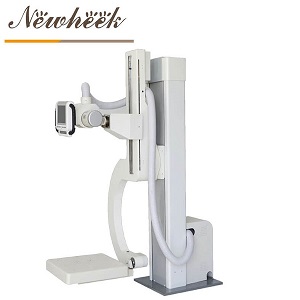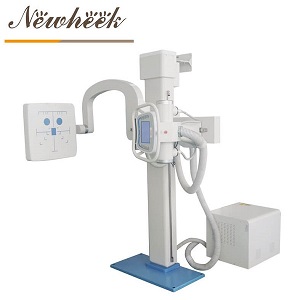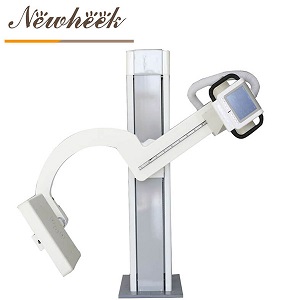

the upright chest film is the highest-volume radiographic exam in most facilities — but “can stand unaided” only covers part of your patient mix. Wheelchair users, frail older adults, post-operative patients and patients with limited mobility all still need chest imaging, and the wall stand — not the tube — decides how much of that mix you can safely take. A bucky stand whose center height reaches down to seated abdomen level, with reachable handholds and cassette sizes from 5″×7″ to 17″×17″, turns “send them to bed level” into “image them upright like everyone else.”
Radiographic positioning references are blunt about the hierarchy: chest radiographs are preferably taken erect. But they are equally blunt about reality — many patients, particularly older adults, cannot stand unassisted for the exposure, and the practical fallback is to image them seated in a wheelchair or on a chair, with the detector placed behind the thorax. The image quality trade-offs of a seated AP are well documented. The equipment question — whether your wall stand can physically get down to the patient — is discussed far less often, and it is the question this article answers.
“Can’t stand” is not one clinical situation. It is at least four, each with different constraints at the wall stand:
1. Wheelchair users and patients with neurological conditions. The workflow starts before the patient reaches the stand: doorway and corridor widths, then transferring to the stand or staying in the chair. For these patients the critical dimension is the lowest position the bucky’s center can reach — a seated abdomen and thorax sit far lower than a standing one. If the detector cannot come down to them, the exam drifts toward a supine or semi-recumbent substitute with all its quality penalties.
2. Older adults with frailty or fall risk. Geriatric imaging references are explicit: older patients may be unable to stand unassisted, and patients with postural instability should never be left alone at an upright stand — a companion or a reachable handhold needs to be part of the setup. A stand with a solid, graspable structure at waist and chest height is not a comfort feature here; it is the difference between imaging upright and not imaging upright at all.
3. Post-operative and monitored patients. Chest follow-ups after surgery are frequent, upright views are clinically preferred, but these patients are tethered to drains, lines and monitoring. They may manage a few standing seconds at the bucky if the transfer is short and something to hold is within reach — or they may only manage a seated or semi-erect position. Workflow speed and one-person operability matter as much as mechanical range.
4. Patients with a larger body habitus or limited mobility. Imaging references note that a broad or deep torso can exceed the detector’s coverage area, producing incomplete images. What helps here is generous cassette-format flexibility — the ability to go from a small segmented field to a full 17″×17″ field, and to orient the detector portrait or landscape to match the patient rather than the fixture.
Before translating this into equipment, it helps to know what the clinical side does. Standard positioning guidance for wheelchair and seated AP chest films runs along these lines:
Two things follow from this list. First, the seated workflow is routine, recognized practice — facilities should expect to run it daily, not as an exception. Second, every one of these techniques physically depends on the detector being placeable at seated height, behind the patient, with the patient stable for the exposure. That is wall-stand territory.
Procurement conversations tend to obsess over the top of the height range. For mobility-limited patients, the bottom of the range matters more. Five specific things to check:
1. How low the bucky center can go. A seated adult’s thorax center sits roughly at wheelchair seat-plus-torso height — far below a standing chest. On our side-mounted bucky stand, the published center-height range runs from 500 mm up to 1,800 mm: the lower figure is what lets a seated or wheelchair patient be imaged with the detector properly centered on the anatomy, instead of collimating around a detector that physically cannot descend far enough. When you compare stands, ask for the lowest bucky-center position in writing — it is the single number that maps most directly to “can we take wheelchair patients upright.”
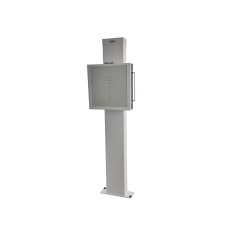
2. Something to hold, within reach. For fall-risk patients, positioning references advise that the patient is never left unattended at the stand and that a supportive handhold is available. A bucky stand with a graspable structure at chest height — or wall-mounted grab points positioned next to the stand — converts “careful, don’t lean on that” into a controlled, supported position. Check the handhold’s location and solidity during the demo, not the brochure.
3. Stability and locking at any height. A stand that drifts after positioning forces re-takes, and re-takes mean repeat dose. Whatever locking mechanism the stand uses, it should hold the chosen height firmly with the cassette loaded — and the patient’s incidental lean should not move it. (Weight ratings and structural limits are a separate engineering topic; ask the manufacturer for written figures and put them in the RFQ.)
4. Cassette size range and detector orientation. Small fields for pediatric or localized work, full 17″×17″ for adult chests — and for broad torsos, the ability to orient the detector to the patient. Our stands take 5″×7″ through 17″×17″ formats in the slot, which covers the range without swapping fixtures. Confirm during the demo that format changes are a one-person, under-a-minute operation.
5. One-person operability. Seated-patient workflows usually run with one operator positioning, one hand on the patient and no third pair of hands. If adjusting the bucky height takes two people, the workflow quietly degrades into “just do it supine.” This is where electric height adjustment with simple locking earns its keep — but even on manual stands, test that one person can reach and operate everything with a patient parked in front of the column.
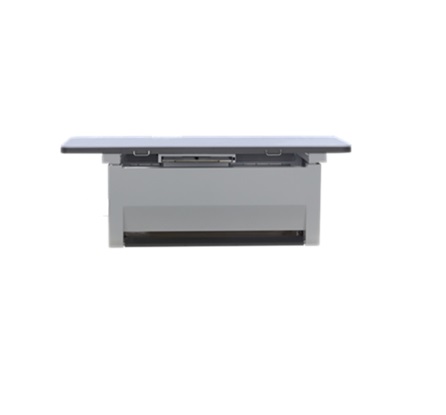
A responsible workflow also admits its limits. Some patients should not be brought to the wall stand at all on a given day: the medically unstable, those who cannot transfer safely even with assistance, patients whose condition only allows a limited reclined position. For them the alternatives are the radiographic table or a mobile radiography setup brought to the bedside — with the detector placed behind the patient where possible and the technique adjusted per protocol.
The point is not that upright is always achievable; it is that the decision should be driven by the patient’s condition, not by the equipment’s reach. A room equipped to handle the seated workflow upright will find that “condition-only” — rather than “condition-plus-equipment” — is the actual bottleneck far less often.
Bring this list to the demo. Each item takes minutes and maps to a real patient situation:
None of these require special instruments, and all of them predict daily reality better than a spec sheet.
Yes. Seated and wheelchair AP chest films are recognized practice in positioning references: the patient sits as upright as possible with the detector behind the thorax, and for patients with a kyphotic curve a slight caudal central-ray angle may be used per the facility’s protocol. The position used should be recorded with the image. What the technique requires physically is a detector that can be placed at seated height — which is where the bucky stand’s lowest center position becomes the deciding spec.
Positioning references describe the semi-erect position — commonly around 30–45° of elevation — as a documented compromise for patients who cannot achieve a true erect position, and the fully recumbent route (table or mobile radiography) for those who cannot be positioned upright at all. The projection choice belongs to the clinical team; the equipment’s job is to make each of these paths executable without improvisation.
References note the trade-offs of non-standard positions — a kyphotic upper thorax can superimpose over the lung apices, and abdominal soft tissue can obscure the lung bases, which is exactly why the caudal angle technique exists. A properly supported seated position with the detector at the right height minimizes these effects; an unsupported one maximizes them. As with all exposures, technique follows the facility’s protocol under ALARA.
Check three things on the stand you already have or plan to buy: the lowest bucky-center height (against your seated patient population), a reachable handhold, and whether cassette formats from 5″×7″ to 17″×17″ are supported without fixture changes. If any of the three falls short, seated workflows will quietly migrate to supine substitutes. Ask the manufacturer for these figures in writing and include them in the RFQ.
If you are specifying a wall stand for a patient mix that includes wheelchair, seated or mobility-limited patients, send us your room layout and typical patient profile — phone/WhatsApp +86 19062611512, email admin@newheek.cn, or use the contact form, and we will walk through the height range, handholds and cassette formats against your real cases.
Tel: +86 19062611512
Email : admin@newheek.cn
Company : Weifang Newheek Electronic Technology Co., Ltd.