
A Bucky stand — usually called a wall stand — is the vertical column that stands against the wall of every radiography room and holds the detector (and usually an anti-scatter grid) at the height where upright work happens. Chest exams, upright abdomens, heads, pelvic views on seated patients: whenever the patient stands or sits facing a flat panel, the Bucky stand is the piece of equipment quietly doing three jobs at once — carrying the detector, cleaning up scattered radiation, and giving both patient and technologist a fixed reference position.
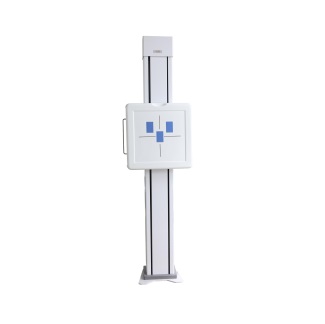
Strip away the sheet metal and a Bucky stand is doing three things:
Inside the carriage there is also a less visible part: a counterbalance (balance device) that carries the weight of the bucky drawer, so the carriage glides to a new height and stays where you put it instead of sliding down under gravity.
Product pages are full of dimensions, but four numbers decide whether a wall stand will serve your patient population. These are the published figures of our side-mount Bucky stand as a worked example:
| Number | Specification | Why it matters |
|---|---|---|
| Bucky travel | 1,300 mm maximum travel on the column | How much of the patient height range one stand can cover — from a seated child to a tall adult standing flat-footed |
| Bucky center height range | 500–1,800 mm from the floor (17″ × 17″ center) | 1,800 mm covers standard upright chest geometry; 500 mm brings the center down to a wheelchair patient or a seated abdomen |
| Slot thickness | Accepts boards up to 19 mm thick | Detectors, cassettes and protective covers differ in thickness — an incompatible slot means the panel will not seat or lock |
| Accepted sizes | 5″ × 7″ up to 17″ × 17″ | From small extremity cassettes to the full-field panel used for chest and abdomen |
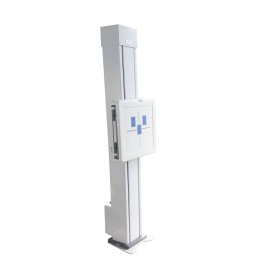
Two derived positions are worth checking against your workflow: on this stand the top edge of the bucky reaches from 750 mm up to 2,050 mm, and the bottom edge from 250 mm up to 1,550 mm. In practice that means one device covers upright chest at full extension and a pelvis or abdomen exam on a seated patient at the bottom of its travel — no re-mounting, no second station.
Column fixed to floor and wall, carriage in front, bucky drawer that pulls out for loading. This is the workhorse described by the numbers above — the configuration most radiography rooms mean when they say “wall stand”. Details here: side-mount Bucky stand.
The carriage can move by hand or by motor. Manual is fewer parts and fewer failure points; electric lift pays for itself in high-throughput rooms where the height changes between every patient. The counterbalance quality matters more than the drive type — it decides whether the height you set is the height that stays.
The same carriage-and-column idea mounted on a wheeled base, so the upright station can be moved between rooms or repositioned around the patient.
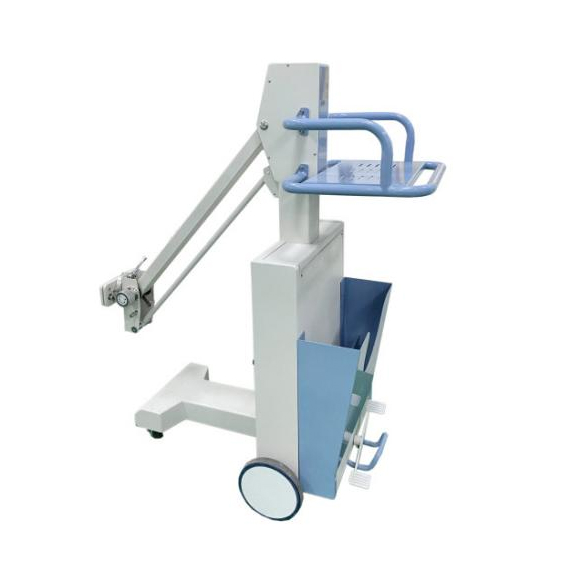
A lighter, take-to-the-patient version used with mobile X-ray units — ward rounds, emergency cover, temporary screening stations. See the portable Bucky stand and the trolley-style Bucky stand for the two non-fixed formats.
The grid is the difference between a crisp upright chest image and a gray one on any patient thicker than a hand. Our side-mount stand takes an optional grid with 40 lines/cm grid density, a 10:1 grid ratio and a 180 cm convergence distance — that convergence distance is not arbitrary: it matches the standard upright chest focus distance, so the grid cleans scatter without cutting off image density at the edges. Whether a grid can be fitted to a given stand type, and what to check before ordering one, we answer separately here: Can an X-ray grid be placed on all types of Bucky stand?
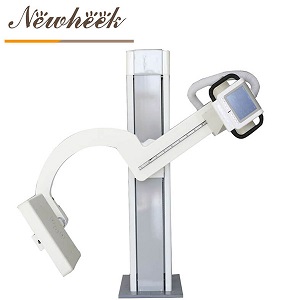
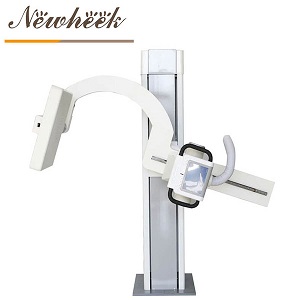
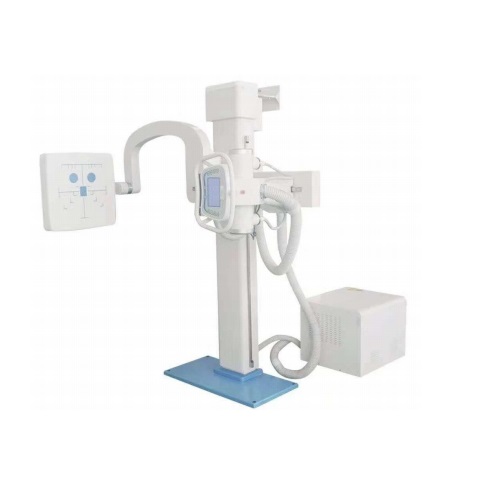
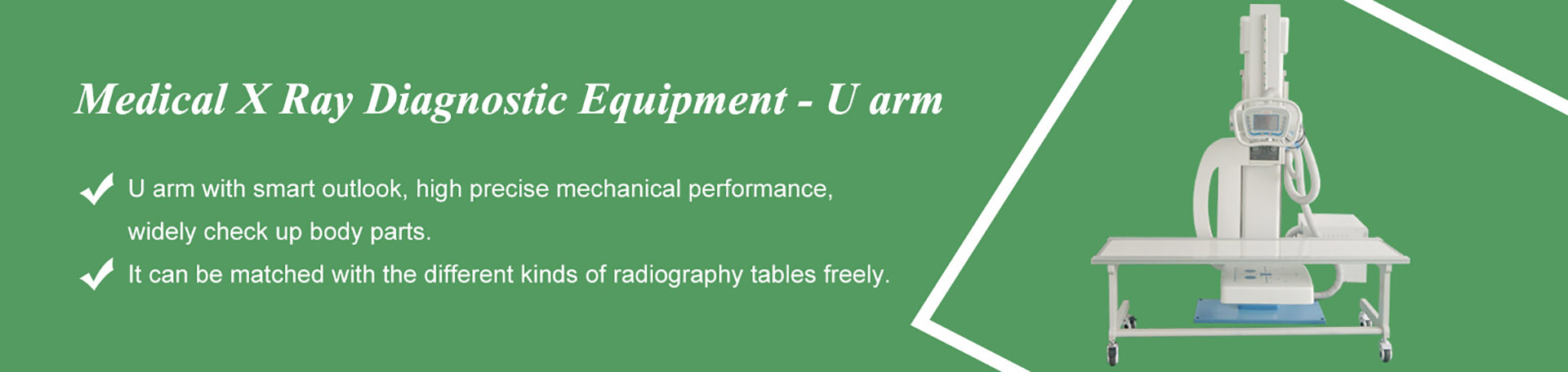
A U-arm system already carries its own detector on the arm — so why add a wall stand at all? Because the two pieces divide the work: the U-arm covers standing, seated and supine work where the machine should move around the patient; the wall stand gives you a dedicated upright station that never needs re-configuring, which is what keeps a chest-heavy schedule flowing. Patients line up at the wall stand while the previous examination finishes at the table — one room running like two. How the rest of the room is planned around both pieces — floor loading, wall anchors, power and the arm’s sweep clearance — is covered in our room requirements guide, and the machine side is explained in the sickle arm explainer.
For the configuration around the stand — machine, table, detector — start from the U-arm and UC-arm naming explainer, and if budget is the next question, the transparent breakdown is here: What does a U-arm X-ray system cost in 2026?
Yes — two names for the same device: the vertical column that holds the detector and anti-scatter grid for upright radiography. “Bucky” refers to the bucky drawer mechanism that carries grid and receptor together.
A modern stand is built to accept ordinary film cassettes, CR imaging plates and DR flat panel detectors — our side-mount stand accepts boards up to 19 mm thick, from 5″ × 7″ cassettes up to a 17″ × 17″ panel. Always check the slot thickness against your panel with its cover fitted.
Because it decides which patients one stand can serve without accessories. A center range of 500–1,800 mm covers a standing adult chest at the top and a wheelchair or seated abdomen at the bottom — one device for the whole upright caseload.
For thin extremities, usually not; for upright chest, abdomen and pelvic work on adults, a grid is what keeps scatter from washing out the image. Match the grid’s convergence distance to your working distance — 180 cm convergence matches standard upright chest geometry.
A U-arm can do upright work at its own wall bucket, so a separate wall stand is not strictly mandatory — but a dedicated Bucky stand turns the upright station into a fixed, repeatable position and lets a chest-heavy schedule run in parallel with table work. High-volume rooms almost always add one.
Tell us your room layout, your detector type and your patient mix — we will match the stand type and grid specification to it. Fill in the inquiry form in our Contact Us module with your name, email, country and requirements, and our product manager will get back to you as soon as possible (within 24 hours on working days, Monday–Saturday). You can also reach us directly at admin@newheek.cn or WhatsApp +86 19062611512.
Tel: +86 19062611512
Email : admin@newheek.cn
Company : Weifang Newheek Electronic Technology Co., Ltd.