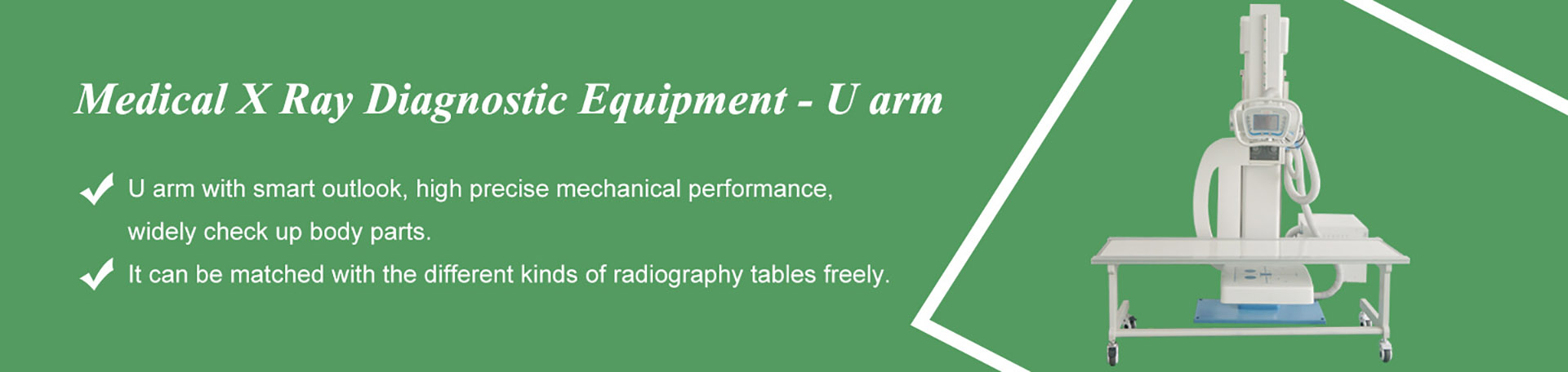

a serious U-arm quotation should be accompanied by a documentation package, not just a specification sheet. At minimum, ask for: (1) regulatory clearance or registration evidence for your destination market (CE marking under MDR in the EU, FDA clearance in the US, or the local registration requirement elsewhere), (2) test evidence against the IEC 60601 safety standards family, (3) a DICOM Conformance Statement if the system promises PACS connectivity, and (4) quality-system and traceability documents such as ISO 13485 evidence and the device’s unique identification data. None of these are paperwork for its own sake — each one answers a question you will otherwise have to answer the hard way, after delivery.
Buyers evaluating a sickle-arm (U-arm) X-ray machine tend to compare kV, generator power and detector size — and stop there. But across export markets, the most expensive mistakes in DR room procurement are rarely technical; they are documentary. A system that cannot be registered locally, cannot prove conformance to the safety standard your inspector cites, or cannot actually talk to your hospital’s PACS despite the brochure claim — each of these turns a good price into a bad purchase. This article lists the files a compliant U-arm supplier should be able to hand you, what each file actually proves, and how to verify rather than assume.

A U-arm system is a regulated medical device almost everywhere it will be installed. The consequences of missing paperwork differ by market, but they exist everywhere:
Industry procurement guides aimed at hospital buyers make the same point in stronger terms: certification files and PACS/DICOM compatibility evidence belong among the core criteria for evaluating any manufacturer, before price is even discussed. Our experience answering overseas inquiries — from Indonesia, Germany, Australia and beyond — is that the buyers who ask for documents early are also the ones whose projects finish on schedule.
| File / evidence | What it actually proves | What to verify |
|---|---|---|
| Market clearance or registration (CE certificate / FDA clearance letter / local registration certificate) |
The device — or the specific configuration you are buying — has been through a regulatory pathway in a reference market | Scope and validity: does the certificate cover this generator class and configuration? Is the named legal entity the actual manufacturer? Is it still within its validity period? |
| IEC 60601 family test reports (60601-1 general safety, 60601-1-2 EMC, 60601-2-54 for radiography) |
The system passed the international baseline safety and electromagnetic-compatibility tests for medical electrical equipment | Which lab issued the report, which edition/standard version was applied, and whether the tested configuration matches what you are buying |
| DICOM Conformance Statement | Exactly which DICOM services the system supports (Storage, Modality Worklist, Print, MPPS…) and how — the honest version of “PACS compatible” | That the listed services match your hospital’s integration requirements, not just the brochure’s one-line claim |
| ISO 13485 quality-system evidence | The manufacturer runs a certified quality management system for medical devices — the process behind the product | Validity and scope; a certificate of the factory, not a trading company |
| Factory test & acceptance records (generator output, dose output, interlocks) |
The specific unit that will ship you has been functionally tested, not just the product line in general | Whether a pre-shipment test with your actual configuration is offered, and what report you will receive |
| Unique device identification & labeling package (UDI where applicable, labels in destination-market language) |
The device can be identified, traced and recalled if ever necessary — increasingly a legal requirement, not a courtesy | Label language, UDI presence where your market requires it, and manual availability in the required language |
Which document heads the package depends on where the room will be installed:
One honest caveat that protects you as a buyer: requirements and certificate scopes vary by market and configuration. A responsible supplier will not hand you a single certificate as a universal answer; they will map the documentation to your destination market’s current rules. Treat any vendor who says “we have CE, so it’s fine for everywhere” as a risk signal rather than a reassurance.
“PACS compatible” is a marketing phrase; a DICOM Conformance Statement (DCS) is the auditable version of the same claim. It lists, service by service, what the device’s DICOM implementation actually does — image Storage, Modality Worklist, Query/Retrieve, Print, storage commitment, and so on — together with the details that determine whether two systems truly interoperate.
Why it matters in practice: hospital IT departments evaluate new modalities against their PACS/RIS integration requirements using the DCS. Procurement guides for hospital buyers repeatedly flag the same failure mode — a system arrives claiming PACS connectivity, and integration then stalls because a required service or a detail of implementation was never documented. Asking for the DCS before signing converts that risk into a checklist item.
As a concrete example of what a documented claim looks like: our own U-arm product documentation states support for the international DICOM 3.0 standard for PACS connection, image transmission and printing. That is the level of specificity a DCS expands upon — every promised service listed and testable, so your IT team can validate it during acceptance rather than discover gaps after installation.

Copy this into your next inquiry and ask the supplier to respond item by item:
A supplier who answers all seven without hesitation has already told you something important about how the next five years of service will go. For the commercial side of the same conversation, see our guide to what a U-arm X-ray system costs in 2026, and for the room-side prerequisites, our U-arm room requirements checklist.
Some national authorities accept it as supporting evidence, but most run their own registration process and may still require local-language labeling and local testing. Never assume CE alone unlocks any market — confirm with your local regulator or ask the supplier which registrations they hold for your country.
Judge each document, not the bundle: check issuer, scope, configuration coverage and validity for every certificate. A package is only as strong as its weakest item — and the weakest item is usually the one whose scope doesn’t match the machine you’re buying.
The documents should still trace back to the actual manufacturer: factory ISO 13485, factory-issued test records, and clarity about who the legal manufacturer is in your market’s terms. Ask the distributor to state the manufacturing entity in writing.
Before. Your hospital’s IT team should review the DCS during evaluation, and the acceptance test at installation should verify the documented services. After signing, your only leverage is a promise.
The safety standard family covers the complete medical electrical system, and reports should reflect the configuration as offered. This is exactly why the checklist asks for the configuration that was tested, not just that a test exists somewhere in the file.
Need a documentation package for your market, or a DICOM Conformance Statement for your hospital’s IT evaluation? Contact us and we will map the file list to your destination country’s requirements:
Related reading: U-arm vs UC-arm explained, how to cut repeat exposures on a U-arm system.
Tel: +86 19062611512
Email : admin@newheek.cn
Company : Weifang Newheek Electronic Technology Co., Ltd.