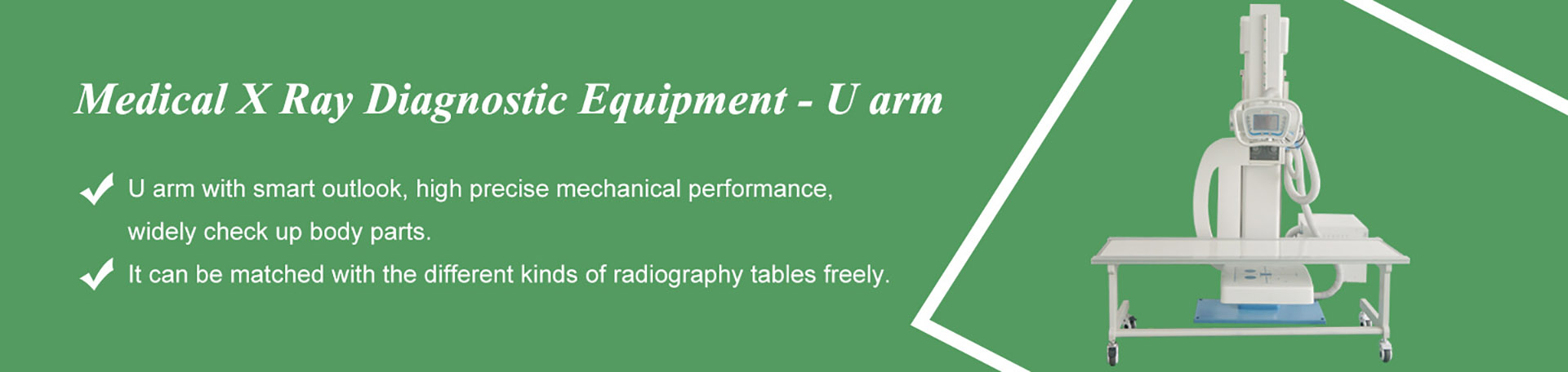

Quick answer: both systems put an X-ray tube and a detector in a fixed radiography room — the difference is where the tube hangs. A ceiling-mounted system suspends the tube from a rail in the ceiling and buys you nearly unlimited tube travel, at the price of structural work, a bigger footprint, and a longer installation. A U-arm fixes the tube and the detector on opposite ends of a single column-mounted arm, trades some positioning freedom for permanent alignment, a small floor footprint, and a much simpler install. If your caseload is mostly upright and table work in a modest room, the U-arm is usually the rational buy. If you run trauma lists, cross-table laterals and unusual views every day, the ceiling system earns its cost. The rest of this article breaks the decision into the six dimensions that actually drive it.
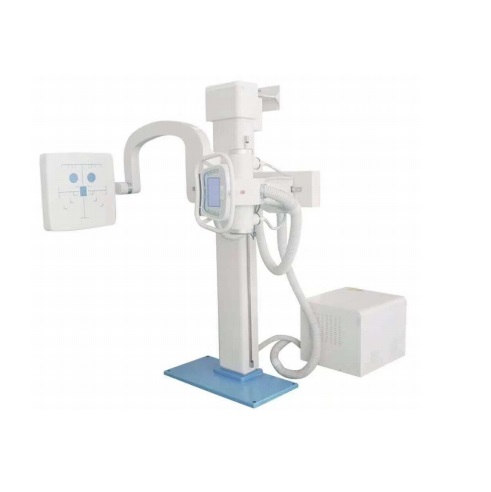
A ceiling-mounted system — often called a floor-to-ceiling or suspended tube system — carries the X-ray tube on a carriage that slides along one or more rails anchored to the ceiling. The tube can travel across the room, up and down, and usually rotate freely, while the patient is positioned at a freestanding table or a wall stand. The room’s ceiling is part of the machine: the rail run, its reinforcement, and the cable management above it are engineered into the building, not bolted on afterwards.
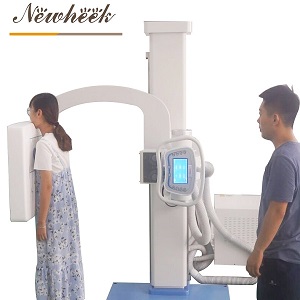
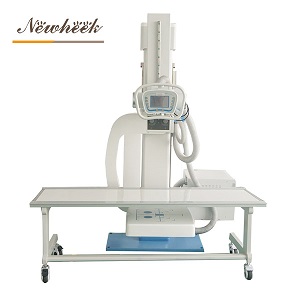
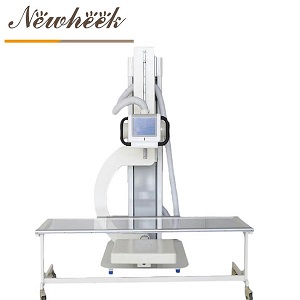
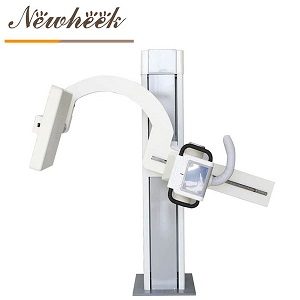
A U-arm puts the tube and the flat detector or cassette holder on the two ends of a rigid, U-shaped arm that rotates and slides on a single floor-mounted column. Because both imaging components live on the same rigid arm, they stay aligned with each other no matter where the arm goes — the operator positions the arm, not the tube and the detector separately. The patient stands at the arm’s wall-stand side or lies on a table while the arm rotates around them.
That single geometric difference — tube hangs free from the ceiling, versus tube and detector locked on one arm — is the root of every advantage and disadvantage below.
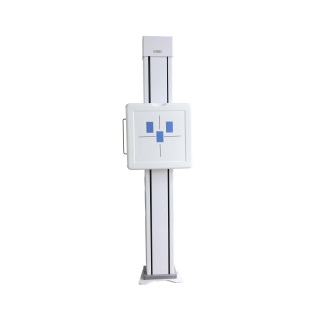
This is where the two systems diverge most sharply, and where retrofit projects get their surprises.
A ceiling system needs a structurally verified ceiling: rail anchor points, load paths, and clearance for the suspended assembly to travel its full range. In new construction this is designed in; in a retrofit, it can mean opening the ceiling, adding steel, and coordinating structural engineers — work that happens before the machine even arrives. The floor also carries the table and wall stand as separate installations.
A U-arm needs one column position: a floor plate, power and control cabling to that point, and enough clearance for the arm’s rotation envelope. No ceiling work is required, which is why U-arms so often land in renovated clinics, converted consultation rooms, and buildings where the ceiling hides cables, ducts, or a slab that cannot take anchors. The rest of the room checklist — true ceiling height, floor quality, power, shielding — applies to both systems and is covered in detail in the site’s guide to U-arm room requirements, and the pre-delivery inspection logic in what to check before the U-arm ships.
Edge: U-arm, decisively, whenever the room is existing and the ceiling is not available to the project.
A ceiling installation is a project: structural prep, rail alignment, suspension assembly, then calibration of a multi-axis suspended assembly. A U-arm install is a fraction of that — position and fix the column base, run the cabling, mount the arm, calibrate. Facilities that need a radiography room operational in days rather than weeks, and clinics that may relocate within the same building or to a new site, consistently favor the column approach: a U-arm can be un-bolted, moved and re-commissioned in a way a ceiling rail installation realistically cannot.
Edge: U-arm, for install speed, disruption, and relocation freedom.
Here the ceiling system takes the lead, and it is important to be precise about why. A suspended tube travels anywhere in the room’s working volume: it can angle across the table, shoot laterally at an off-center position, drop low for cross-table work, and reach positions no rigid arm geometry allows. For departments doing cross-table laterals, decubitus views, trauma positioning and unusual projections daily, that freedom is not a luxury — it is the caseload.
A U-arm covers upright, table and seated work excellently, and its one-button rotation between upright and recumbent geometry is faster than repositioning a suspended tube for routine views. Its limits appear at the edges: true cross-table and decubitus work, and heavily angled projections, are constrained by the arm’s geometry. These limits, and the workarounds, are documented honestly in the article on lateral, oblique and cross-table exams on a U-arm. A buyer should read that article before choosing, not after.
Edge: ceiling system, for positioning freedom — provided the caseload actually uses it.
For a general radiography room — chests upright, extremities at the wall stand, abdomens on the table — the U-arm’s fixed geometry is a productivity feature, not a compromise. Alignment is never knocked out of calibration by a well-meaning technologist pushing the tube somewhere creative; the same study is performed the same way every time, which also makes technique charts and follow-up comparisons more consistent. Patient flow benefits too: one control moves the whole arm between upright and table geometry, which matters with elderly, bariatric and limited-mobility patients — the workflows described in difficult-patient positioning on a U-arm — and with children, where a short, predictable exam is the whole game, as covered in pediatric and neonatal imaging on a U-arm.
A ceiling system also handles this routine work perfectly well — it simply does not pay for itself with routine work. Its flexibility only returns value when irregular views are frequent enough to be routine themselves.
Edge: U-arm for consistency and routine throughput; ceiling for mixed and trauma-heavy lists.

Purchase price always reflects what the machine carries: a ceiling system buys rails, carriages, suspension and a long cable chain; a U-arm buys one column and one rigid arm. But the purchase price is the smaller half of the story. Installation for a ceiling system typically adds structural and ceiling work that can rival the equipment cost in retrofit scenarios, and the ongoing maintenance envelope is larger — rails, brakes, cable carriers and suspension components all age and need service. A U-arm’s moving parts are concentrated in one arm mechanism on one column, which concentrates maintenance into a single, predictable item.
This article deliberately quotes no figures, because both categories vary enormously with configuration. The honest budget statement is structural: the ceiling system’s costs arrive earlier (installation) and spread wider (more components), while the U-arm’s costs arrive mostly with the crate.
Edge: U-arm, for total cost of ownership in typical clinic scenarios; the gap narrows only in purpose-built, high-throughput departments where flexibility is monetized daily.
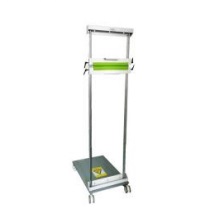
A point buyers often miss: the two systems do not have to be rivals, because a mobile unit covers the occasional views that a U-arm room handles awkwardly. Departments that own a U-arm plus a mobile machine send the rare cross-table or bedside study to the mobile unit, and the fixed room keeps doing high-volume routine work without compromise. The division of labor between fixed and mobile radiography is explained in what a sickle arm is actually good at. If irregular views are genuinely occasional, “U-arm plus mobile” frequently beats “ceiling system alone” on both cost and uptime.
Edge: contextual — this combination is often the pragmatic answer for mid-size hospitals.
Three honest boundaries. First, this article compares the tube-and-generator architecture only; the detector decision — wired or wireless, size, workflow — is a separate axis with its own trade-offs. Second, the table and wall stand in either room carry their own specifications and selection logic, which live with the bucky stand and table product lines rather than in a gantry comparison. Third, the two categories blur at the edges: some mid-column systems borrow features from both, and the site’s explainer on U-arm versus UC-arm covers one such variant, while U-arm versus C-arm clarifies the static-versus-fluoroscopy boundary that buyers also frequently ask about.
No. Both architectures are generator-and-positioning platforms, and both accept digital detectors or cassette-based imaging. Digitization is a detector and software decision, independent of how the tube is mounted.
Yes — upright laterals are standard U-arm work, with the patient between the tube and detector sides of the arm. The constrained cases are cross-table and decubitus geometry, which the angled-views article linked above explains in detail.
In most small-clinic scenarios the U-arm wins on every practical axis: footprint, installation speed, disruption, cost, and maintenance reach. The ceiling system becomes the better answer when the clinic’s caseload genuinely includes complex views daily, or when it is part of a larger department’s build.
It needs engineered anchor points and load paths where the rails mount, plus clear travel envelope — not necessarily reinforcement of the entire ceiling. But determining that requires structural assessment, which is precisely the cost and schedule risk a U-arm avoids.
Frequently, yes — the two rooms coexist in many departments, with the U-arm room absorbing routine volume and the ceiling room added for advanced work as the caseload grows. Planning power, shielding and room dimensions with that possibility in mind makes the later addition straightforward.
The fastest way to a confident decision is to describe the actual room and the actual caseload: floor dimensions, ceiling situation, studies per day, and the views your team performs most. We will tell you honestly which architecture fits — including the cases where the answer is “neither; you need a mobile unit alongside.” Reach us through the contact page, by email at admin@newheek.cn, or by phone and WhatsApp at +86 19062611512, or browse the U-arm digital radiography system range to see the column-based architecture in its current form.
Tel: +86 19062611512
Email : admin@newheek.cn
Company : Weifang Newheek Electronic Technology Co., Ltd.