
a stationary X-ray machine is any radiography system installed in a fixed location — a dedicated room with fixed power, fixed shielding and equipment that does not leave the building. The category covers several distinct equipment families: floor-mounted tube-and-table systems, U-arm and UC-arm systems, radiography tables, wall stands and bucky stands, and a handful of special-purpose variants such as veterinary, vehicle-mounted and industrial units. Each family solves a different positioning problem, and each carries its own trade-offs in floor space, patient flow and workflow flexibility. This guide walks through what each family is, where it shines, and where it doesn’t.

In radiography terminology, “stationary” or “fixed” describes where the equipment lives, not how the tube moves. A stationary X-ray machine is installed in one room, connected to mains power (often a dedicated generator), and paired with permanent radiation shielding in the walls. Mobile units roll between wards; portable units travel in a case or a vehicle boot. A stationary system does neither — and that constraint is precisely its strength.
Because the machine never moves, everything around it can be engineered for repeatability: the tube returns to the same address for every chest exam, the table floats to a predictable position, the wall stand sits exactly where patients expect it. Collimator light fields, exposure reproducibility and image consistency all benefit from that stability. The trade-off is equally clear: the patient must come to the machine, which is why stationary and mobile systems coexist rather than compete. We cover that split in detail in our comparison of mobile vs fixed X-ray machines.
“Buying a stationary X-ray machine” is really shorthand for assembling several pieces of equipment into one working room. Catalog pages list them as separate products because they are separate products — and understanding the families is the fastest way to read any stationary lineup sensibly.
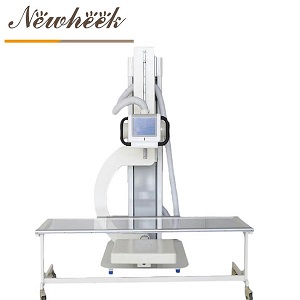
This is the traditional layout: a tube column that travels along the floor or ceiling, a patient table beneath it, and a wall stand for upright work. Suppliers offer the pairing in manual and motorised grades — for example, a manual universal system with a bucky table and wall stand or its motorised equivalent. One tier up sit the intelligent automatic DR rooms, in which the tube column, table and wall stand track each other and pre-position at the press of a preset.
Pros: the most complete positioning coverage of any family — table work, upright work, and everything between; a single supplier is accountable for the whole room’s geometry; motorised tiers dramatically cut per-patient positioning time in high-throughput departments.
Cons: the most demanding installation of any family — floor loading, ceiling height, power supply and shielding all need checking before purchase (our X-ray room requirements checklist covers the verifiable items); manual grades are affordable but every movement costs technologist time; automatic grades cost more and need trained staff to exploit their presets.
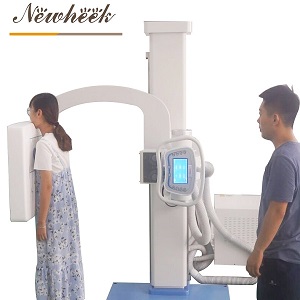
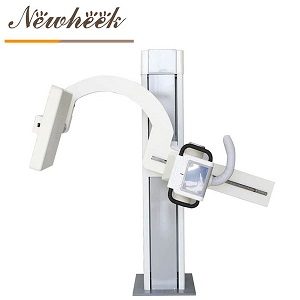
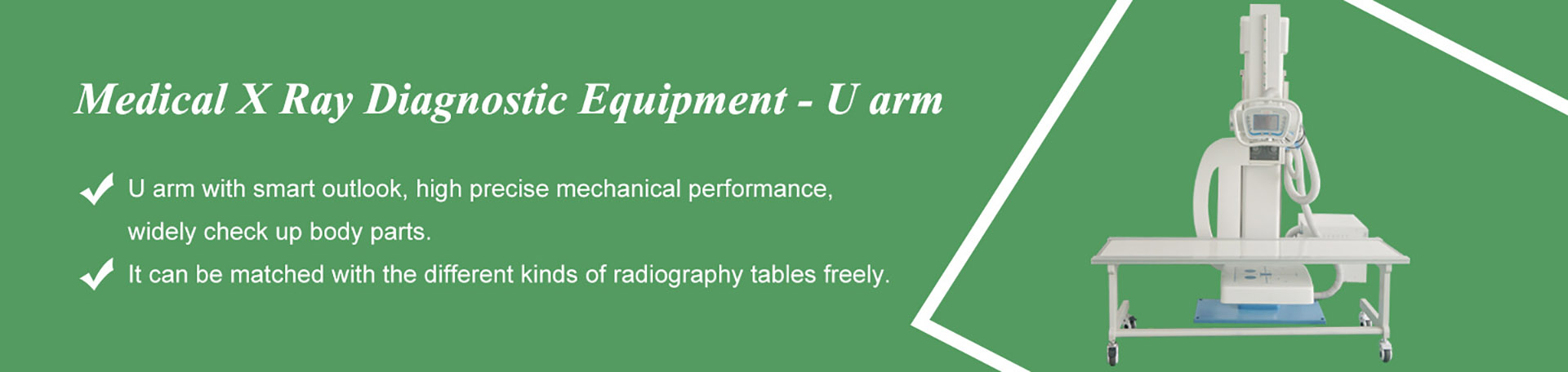
The U-arm family mounts tube and detector on opposite ends of a U-shaped carrier that rotates around a vertical column. The patient can be imaged standing, seated or on a stretcher, with the tube and detector staying aligned through every position. A UC-arm variant adds a rotating arm geometry that lets the assembly swing around the column for cross-table and angled work — our explainer on U-arm vs UC-arm breaks the geometry down. Column systems can also be matched with a radiography table when the room needs recumbent work as well.
Pros: unmatched position flexibility per square meter — one column serves standing, seated and stretcher patients; no ceiling rail and a lighter floor requirement than full floor-mounted rooms; fast patient flow for chest, extremity and trauma-style upright work.
Cons: recumbent work depends on adding a table (or on the patient transferring to a trolley position); angulation is real but bounded — extreme cross-table projections remain the territory of floor-mounted rooms, as our article on sickle-arm and double-column trade-offs discusses; positioning discipline matters, because a mis-aligned U carrier shows up immediately in the collimator field.
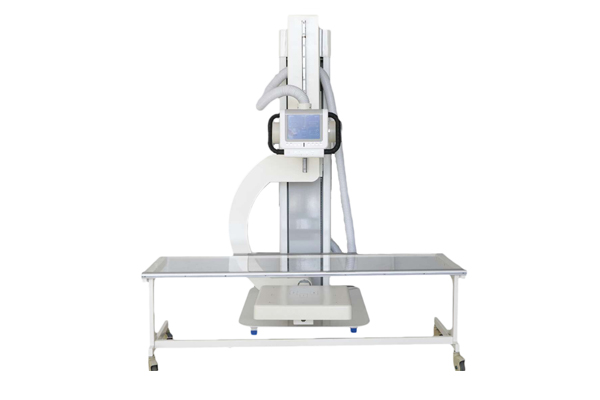
Tables look like the simplest product in the catalog and are the easiest to under-specify. The entry grade is a fixed-height table; the workhorse grade is the four-way floating radiography table, whose tabletop glides longitudinally, laterally and holds position anywhere in its travel — the technologist positions the patient’s anatomy over the detector instead of repositioning the patient. Multifunctional tables add height adjustment and integrated bucky mechanisms; a six-way floating table extends the same idea for U-arm rooms that need finer tabletop control.
Pros: a floating tabletop converts difficult recumbent patients from a two-person lift into a one-technologist slide; built-in bucky grids clean up scatter on thick body parts; a good table outlives several detector generations and anchors the room’s workflow.
Cons: floating tabletops are a moving mechanism — they need locking discipline and periodic maintenance; fixed-height tables strain workflows for wheelchair and stretcher transfers; tables bought without checking bucky size compatibility against the room’s detectors create daily friction. Veterinary practices have a dedicated variant — the veterinary X-ray table — sized and configured for animal patients rather than humans.
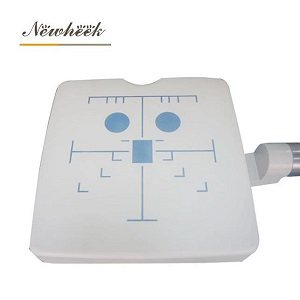
The wall stand (or upright bucky stand) is the vertical carrier that holds the detector for standing patients — chest films above all. The family runs from a simple fixed wall-mounted bucky stand through an electric double bucky stand that carries two detector positions, to motorised units whose carrier travels at the push of a button, such as this motorised wall stand with grid bucky. We maintain a full plain-language guide to what a bucky stand is, plus an evidence-based comparison of motorised vs manual bucky stands.
Pros: a fixed upright address means repeatable chest positioning and fast patient throughput; the wall mount needs no floor footprint beyond its own; grid-equipped versions handle thicker patients without a visible scatter penalty.
Cons: a fixed wall stand serves exactly one position — rooms that also need seated or stretcher upright work need the tube to travel to meet other detectors; height travel is the feature that separates a basic unit from a workflow tool, and it is worth paying for in busy departments; wall stands bolted to the wall limit room rearrangement later.
Three variants round out most stationary catalogs. Veterinary fixed systems pair an animal-sized table with a standard tube column; the imaging physics is identical to human work, but the table surface, restraint options and workflow (sedated, uncooperative patients) differ enough that a dedicated veterinary table earns its place — see our overview of fixed veterinary X-ray machine features. Vehicle-mounted systems such as a vehicle-mounted X-ray unit install a complete radiography chain inside a screening van, trading room-grade stability for the ability to bring imaging to the population. Industrial units, including the station’s industrial X-ray machine category, apply the same stationary principle to non-destructive testing of parts and materials rather than patients.
Pros: each variant is tuned to its workload instead of a human hospital’s; veterinary tables in particular prevent constant improvisation with human-sized equipment; vehicle-mounted systems reach populations no fixed room can.
Cons: smaller variant markets mean fewer reference installations to learn from; vehicle installations inherit every constraint of the van — power, vibration, shielding — before radiography even starts; industrial units follow different regulatory paths from medical ones, so procurement teams should not mix the two workflows.

| Equipment family | Main strengths | Main trade-offs | Best fit |
|---|---|---|---|
| Floor-mounted universal system | Full positioning coverage; one accountable supplier; automation tiers | Most demanding room requirements; manual grade is slow; automatic grade costs more | High-volume hospital radiology departments |
| U-arm / UC-arm column | Position flexibility in a small footprint; fast upright workflow; lighter installation | Recumbent work needs a table; angulation bounded; disciplined positioning required | Clinics, urgent care, compact DR rooms |
| Radiography table (floating) | Easy recumbent positioning; integrated bucky; long service anchor for the room | Moving mechanisms need maintenance; fixed-height grades limit transfers | Every room doing meaningful recumbent work |
| Wall stand / bucky stand | Repeatable chest positioning; zero extra footprint; grid option for thick patients | Serves one position; height travel costs extra; wall fixing limits rearrangement | Chest and upright workloads of any size |
| Special-purpose (vet / vehicle / industrial) | Tuned to the actual workload; reaches sites fixed rooms cannot | Fewer reference installs; vehicle and industrial paths add their own constraints | Veterinary practices, screening programs, NDT labs |
Most real purchases combine two or three families. A compact clinic typically buys a U-arm column plus a wall stand — or the column alone if upright work dominates. A district hospital adds a floating table to that pairing and gets a full-service room. A veterinary practice pairs a column with an animal table and never looks back. The intelligent automatic rooms simply bundle all of it with motorised tracking. The right question is never “which product is best” but “which families does my caseload actually need” — the pairing logic between the tube-carrying half and the detector-carrying half is covered separately in our guide to pairing a tube stand with a bucky stand.
Whichever combination you choose, confirm before signing: the room dimensions against the published installation envelope, the power supply against the generator’s requirement, and detector size compatibility across every carrier in the room. Those three checks prevent the vast majority of stationary-room regrets.
Yes. The column is bolted or floor-mounted in a dedicated shielded room, so a U-arm is a stationary system even though its U carrier swings and rotates. “Stationary” describes the installation, not the motion of the parts.
For mostly upright workloads (chest, extremities), a U-arm or UC-arm column alone is usually enough. If the caseload includes meaningful recumbent work — trauma, elderly or pediatric patients — add a floating radiography table rather than stretching the column beyond its comfort zone.
A fixed table works for low-volume rooms with mobile patients. Any meaningful recumbent volume benefits from a floating tabletop: the technologist slides the anatomy over the detector instead of repositioning the patient, which saves time and reduces staff lifting on every difficult case.
Commonly, yes — many rooms run a motorised tube column with a manual wall stand, or vice versa. What must match is the geometry and detector interchange, not the automation grade. Verify travel overlap and detector formats in writing at quotation time.
The tube, generator and detector side is the same technology. The difference concentrates in the table: surface size, restraint workflow and patient handling for animal patients. Practices imaging anything beyond small companion animals should start from a dedicated veterinary table rather than improvising with human equipment.
Unsure which families your caseload justifies? Send us your room dimensions, exam mix and existing equipment, and we will map them onto a concrete configuration — no obligation.
Tel: +86 19062611512
Email : admin@newheek.cn
Company : Weifang Newheek Electronic Technology Co., Ltd.