
Quick answer: a U-arm stays where an operator puts it because four separate systems share the load. A counterbalance offsets the weight of the arm and detector, brakes resist movement at the column and the rotation joint, locks fix a chosen position mechanically, and castor brakes stop the whole unit from rolling. Each wears at a different rate. A machine that felt firm on the day of installation can drift months later, and the cause is usually one of these four parts — not the imaging chain.
Why does a U-arm need anything to hold it in place?
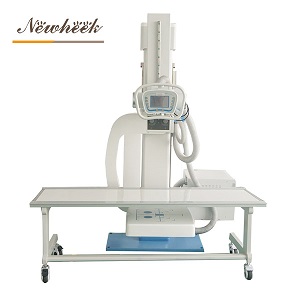
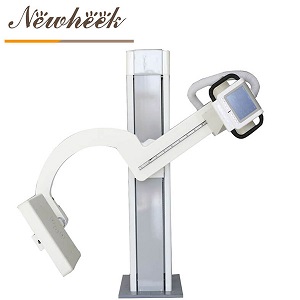
The detector on a U-arm sits at the end of a curved beam, well away from the column that carries it. Gravity is constantly trying to pull that end down. A ceiling-mounted system is bolted overhead and stays put by mass and structure; a U-arm is a floor-standing frame with a moving cantilever, so something has to take the load the moment the operator lets go of the handle.
That moment matters more than it sounds. Positioning is rarely the last step. The detector still needs draping, the patient still needs instructions, and the operator still has to walk back to the console. If the holding system is weak, the detector sinks a little during that walk. The tube and detector are no longer aligned with the anatomy they were set for, and the exposure is repeated.
None of this shows up as a fault code. It shows up as a tech who quietly re-grips the detector before every exposure, and as a reject log nobody has connected to a mechanical cause yet.
What is actually counterbalancing the arm?
Counterbalance is the part that carries the static weight. It is usually a spring or weight mechanism inside the column that offsets the mass of the arm and detector, so moving the arm takes a gentle push rather than a lift. When it is set correctly, the arm feels roughly the same through its travel and stays where it is released while the brake does the fine holding.
Two behaviours point back to balance rather than to a brake. The first is an arm that feels heavy in one direction and light in the other, as if the operator is fighting it on the way down. The second is an arm that creeps upward on its own after being set. Both say the offset no longer matches the load being carried. Adding a different detector or a heavier accessory changes that load, which is why balance can appear to fail after a component swap even though nothing was adjusted.
The counterbalance is normally a sealed, factory-set assembly. It stores energy under tension, and a cover opened out of sequence can release that energy. Anything beyond a check of how the arm feels belongs with the service contact and the manufacturer’s manual, not with a screwdriver at the console.
What is the difference between a brake and a lock?
These two words get used as if they mean the same thing, but they behave differently in the room.
A brake resists motion through friction. It lets the operator stop at any point in the travel — mid-height, partway through the arc — and hold there. Because it is friction-based, it can soften as the surfaces wear, and it can be affected by oil or grit reaching a joint that depends on friction to grip. A soft brake shows up as slow creep: the arm was right, then it was slightly low a minute later.
A lock is positive engagement. A pin or detent drops into a fixed position, and the part either locks or it does not. Locks are used for defined states such as the parked position and the transport position. They are not used to hold a halfway height, because there is no detent there. A lock that fails to engage is more obvious than a soft brake — the arm swings when the machine is bumped — but it is an equally valid reason to stop and report.
The arm rotation and bucky tilt characteristics page describes the travel these parts have to control; the holding system is what makes that travel usable at a chosen point.
How are the column and the rotation joint held?
They are held in two different places, and a drift in one says nothing about the other.
Vertical travel runs on the column. Set the detector at working height, take hand pressure off it, and watch the height. If it sinks under a firm push in several directions, the column brake is the part to question. Rotation is the swing that takes the arm from a wall position to a table position. Set it at one end of that arc, let go, and see whether it creeps back toward the middle. Movement there points to the rotation joint.
This distinction matters because the two joints are used very differently. The column is moved for almost every patient; the rotation is moved when the room switches between standing and lying work. A brake that sees constant small adjustments wears differently from one that makes a few large moves a day. A position used rarely can drift unnoticed while the busy position still feels firm.
A hand-pressure check at working height is one line in the monthly constancy routine. That routine treats brakes as one of several items to measure and record, which is the right framing: a brake is a thing that changes over time, not a thing that is either good or broken.
What do the castors at the base do?
The castors move the whole unit around the room. At least one is lockable, and the lockable ones are what stop the machine rolling during an exposure. They do not stabilise the arm. A room can have a perfectly still base and a detector that still sinks — the two systems are separate, and checking one is not a substitute for checking the other.
Castor brakes hold best on a level floor. That is one reason floor preparation comes up before delivery rather than after: the room requirements for space, ceiling height, floor loading and shielding cover the floor condition the base will sit on. Loose material under a castor is a small thing that becomes an unstable base when the arm is extended.
Before moving the unit across the room, the arm is parked and its transport lock engaged, then the castors are released. Rolling with the arm out at full reach puts the load where the base is least able to resist it. The manufacturer’s moving procedure takes precedence here; if a room needs the unit relocated regularly, that procedure belongs in the local operating note rather than in memory.
Why does a firm brake start to drift?
Friction surfaces change with use. A joint that held cleanly at installation can pick up oil, cleaning residue or fine dust, any of which lowers the grip that the brake depends on. Adjustment can back off over a long run of small movements. Springs fatigue. None of it happens on a schedule that matches a calendar, which is why a fixed “tighten it every quarter” rule is a poor substitute for checking how the arm actually behaves.
Industry maintenance writing describes the same pattern across articulated radiography arms: drift is usually reported late, after operators have compensated for it for weeks, and an early adjustment is a small job while a long-ignored one can need replacement parts. The useful response at the room level is not a repair. It is a note — which position, which load, how long it took to move, and whether the arm moved on its own or only when pushed.
Cleaning can be part of the cause, which makes the part-by-part cleaning guide worth reading alongside this one. Fluid directed at a joint instead of onto a cloth is a common way to change a friction surface without anyone intending to.
What should be checked before the first patient?
Acceptance is the one moment when a soft holding system is easy to raise, because the machine is new and the supplier is present. A short list covers most of it:
Check that the detector holds height under hand pressure in several directions, at a working position rather than at a travel limit. Check that rotation holds at both ends of its arc and returns to the same point after a full swing. Check that the castor brakes hold with the detector extended, not tucked in. Cycle the travel and listen for a new sound that was not there when the crate was opened. Press the emergency stop and confirm motion ceases. Then repeat one positioning move twice and confirm the detector lands in the same place each time.
Each observation is written down against the written specification for the machine. A result that is “roughly right” is not a result that can be argued about later. If the room is still being prepared, the room requirement baseline gives the conditions those checks assume.
What belongs in the purchase order about the holding system?
Most purchase orders describe the imaging chain in detail and say nothing about the parts that keep the geometry in place. That leaves the buyer without a benchmark when drift appears. A few lines close that gap without requiring any specialist language:
Ask for a written list of which joints use brakes and which use locks, and at which positions the locks engage. Ask whether the counterbalance is sealed or field-adjustable, and who is permitted to adjust it. Ask for the stated check interval and for the name of the person who performs it. Ask which friction assemblies are stocked as spares and how quickly they can be supplied. Ask what the supplier counts as normal wear and what counts as a defect, in writing.
Those questions sit naturally beside the service and spare-parts terms in the downtime planning guide. A holding system that can be adjusted locally and has parts available is a different proposition from one that needs a visit for every small change, even when the two machines look identical in a brochure.
What can operators do, and what belongs to service?
Daily habits are simple and they cost nothing. Position the arm with a steady hand rather than letting it reach a travel stop. Engage the transport lock before moving the unit. Keep the floor under the base dry and clear. Record drift the day it is noticed, with the position and the load.
Internal friction assemblies, clutch surfaces and the counterbalance belong to service. An external handle on a joint is not an invitation to add force: over-tightening a friction assembly can damage the parts it was meant to protect, and a loaded spring assembly is a genuine injury hazard if opened out of sequence. The precautions during use page covers the handling habits around the arm; the manufacturer’s service manual governs anything that needs a cover removed.
Where the holding system fits next to the rest of the machine
It is tempting to read a fresh reject pattern as an image-quality problem and start at the detector. The holding system is upstream of that. If the arm does not return to the same geometry, no amount of image processing restores the position it was meant to have — and an auto-tracking feature can hide a mechanical issue for a while by compensating for it each time.
The structure and motion range overview describes what the arm is built to do. The holding parts described here are what let those movements land at a chosen point and stay there through a working day. Both are part of the same specification, and both deserve a line in a request for quotation.
Frequently asked questions
Can a soft brake be fixed by tightening a handle the operator can reach?
Not as a general rule. Some joints have an external adjuster, but internal friction and clutch settings follow the manufacturer’s sequence, and adding force without that sequence can damage the assembly. A recorded change in how the arm holds is a service question. The service manual decides what is operator-accessible on a given machine.
Does an arm that drifts mean the detector is damaged?
Usually not. The detector is along for the ride, and a slow sink of the arm is a mechanical change rather than an imaging-chain fault. The two can be confused because both end in a repeat exposure. Note the drift first, then check the image; investigating both together avoids replacing a detector that was not at fault.
How often should brakes and locks be checked?
Schedules differ between manufacturers and between local policies, so the written instruction for the machine takes precedence. Many rooms fold a hand-pressure check into a monthly constancy routine and record the result. Caseload changes the right interval: a joint moved for every patient is checked more often than one moved only when the room changes layout.
Can the unit be rolled across the room with the arm extended?
Park the arm and engage its transport lock before moving the base. Rolling with the detector at full reach leaves the load where the base resists it least. The manufacturer’s moving procedure is the authority for a specific machine, and a room that relocates the unit regularly should keep that procedure on site.
Is a locked castor enough to keep the machine still during an exposure?
No. The castor brake stops the base rolling; it does nothing about the column or the rotation joint. A base can be perfectly still while the detector sinks. Acceptance checks cover the two separately, with the detector extended for the castor check so the base is tested under the load it will actually carry.
Phone / WhatsApp: +86 19062611512 | Email: admin@newheek.cn